A collaborator leaving a project creates two distinct tasks: ending access and preserving the information the site should retain. Deleting an account without reviewing its content can turn an ordinary handover into an editorial cleanup.
List the accounts and credentials associated with the person. WordPress is only one part of the list; hosting, domain registration, email, code repositories and plugin licenses may be separate. Revoke access through each service's supported process rather than assuming a WordPress password change covers everything.
Within WordPress, review the user's role, published content, drafts and application passwords. Decide which records need a new responsible person. Built-in user deletion offers content reassignment options, but data owned by extensions may require their own procedure.
Make the ownership decision explicit
Reassigning posts can change the visible author. That may be appropriate for organizational pages but not for an article whose attribution should remain with its writer. Decide the editorial treatment before selecting a bulk option. Preserving a byline and preserving login access are not necessarily the same requirement.
Check integrations that run under the departing person's account. A scheduled import or publishing connection may fail when its credentials are revoked. Move the task to an authorized owner, test the replacement and then remove the obsolete access.
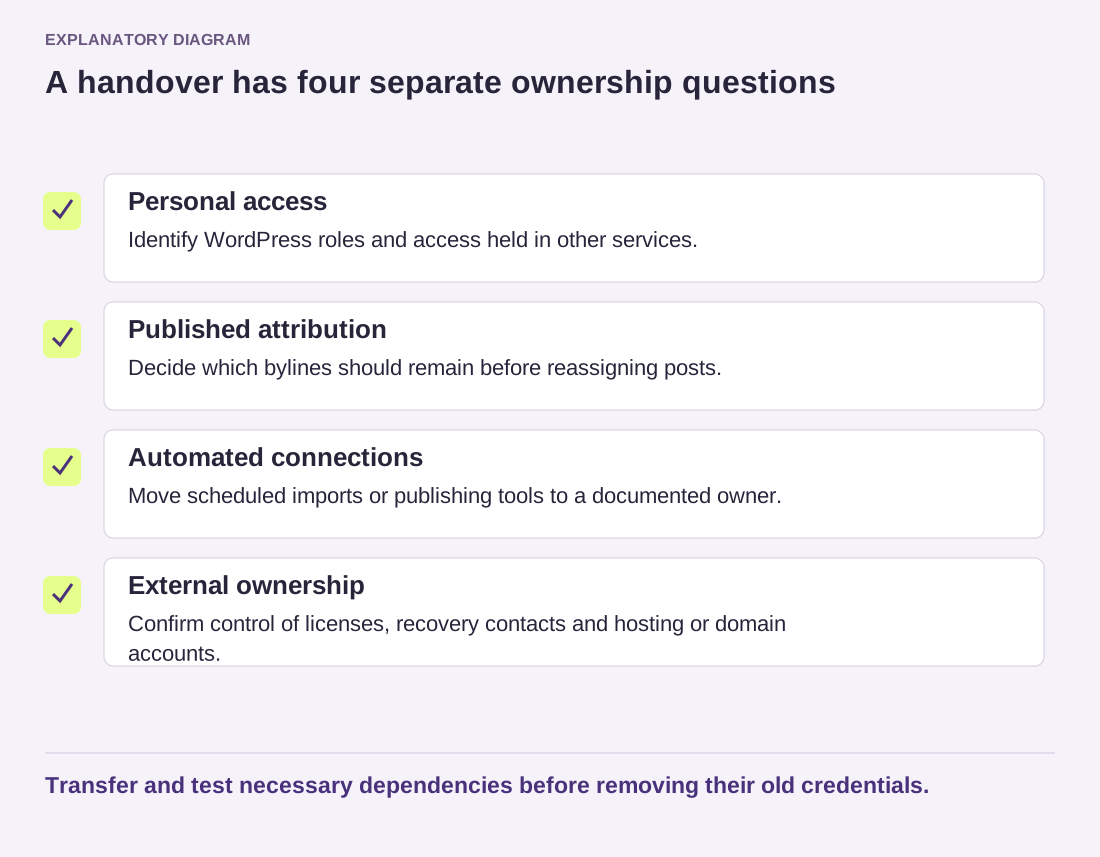
Read the diagram as text
- Personal access: Identify WordPress roles and access held in other services.
- Published attribution: Decide which bylines should remain before reassigning posts.
- Automated connections: Move scheduled imports or publishing tools to a documented owner.
- External ownership: Confirm control of licenses, recovery contacts and hosting or domain accounts.
Transfer and test necessary dependencies before removing their old credentials.
Retrieve necessary project documentation and confirm that the organization controls relevant licenses and recovery addresses. Avoid asking for a person's private password; use account transfer or invitation mechanisms provided by the service. Keep shared secrets out of ordinary handover documents.
After the change, test the tasks the remaining team must perform and inspect a few affected published pages. Record who now owns the maintenance responsibilities. The process is complete when access has ended without leaving broken integrations, lost drafts or unexplained changes to the site's authorship.
If a dependency cannot be transferred immediately, assign it an owner and a completion date. An unresolved note is not a substitute for a controlled remaining access arrangement.