The page is readable, the menu responds and the contact form works. There are still suggestions in the performance report. That can be uncomfortable if you expect the report to end with an empty list, but a list of possible improvements is not automatically a list of worthwhile changes.
Consider a proposed script delay that slightly improves the initial result but makes the search box respond only after another interaction. A visitor who came to find an answer now has a worse experience. The optimization has shifted the cost to a task that mattered more than the number being watched.
Set a boundary before experimenting
Write down the problem you still need to solve. It might be a visible pause on an ordinary phone, an unstable article heading or a slow first response during a particular period. State which visitor task is affected. If you cannot identify a remaining problem beyond wanting the score to be perfect, pause before making another complicated change.
Chrome's Lighthouse guidance says a perfect performance score is not expected and explains that high-end gains become harder to achieve. That does not make performance unimportant. It means the final few points deserve the same scrutiny as any other work competing for your time.
Estimate the whole cost of the proposal. A custom workaround may require retesting whenever a plugin updates. A replacement service may add a subscription and another configuration to maintain. Removing a feature may save loading work while also removing the reason some readers visit. Put those consequences next to the measured benefit.
Choose a stopping condition you can explain
One sensible boundary is to stop an experiment when repeated, comparable runs show no convincing improvement in the problem being investigated. Another is to stop when the required workaround breaks an essential task or makes routine maintenance uncertain. These are decisions about the experiment; they are not a declaration that the site can never improve.
For example, an article site may decide that removing a decorative animation is worthwhile because the page becomes simpler and navigation feels steadier. The same site may reject a complicated font-loading modification after it causes distracting text changes and offers no clear gain in the selected test. Neither choice needs a universal score threshold.
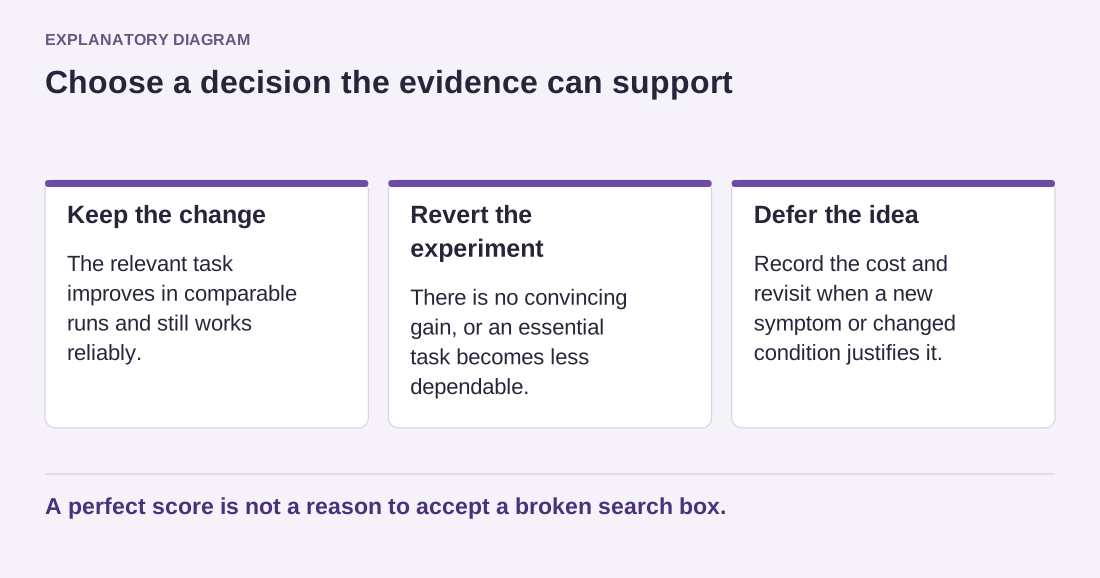
Read the diagram as text
- Keep the change: The relevant task improves in comparable runs and still works reliably.
- Revert the experiment: There is no convincing gain, or an essential task becomes less dependable.
- Defer the idea: Record the cost and revisit when a new symptom or changed condition justifies it.
A perfect score is not a reason to accept a broken search box.
Keep a short list of deferred ideas with the reason for postponing each one. Revisit them when there is new evidence: a changed audience, a new template, a repeatable complaint or a different hosting constraint. That is more useful than reopening the same low-impact adjustment every time a report displays it.
Stopping allows the next hour to go toward something else that matters, such as fixing a broken link or clarifying an outdated explanation. Leave the site in a state you can maintain, with the successful changes documented and unsuccessful experiments removed. A dependable page is an outcome worth protecting.