An activity log is valuable when it answers a question you otherwise could not resolve. Who changed a user's role? When was a plugin activated? Which account edited a critical page? Collecting every available event without a purpose can produce a large archive that nobody reviews.
Identify the decisions the log will support. A small editorial site may care about publishing and permission changes. A store may need additional events from its commerce extension. Do not assume WordPress core automatically maintains a complete audit trail for every action; coverage depends on the logging tool and its integrations.
Check how events identify people and time. Individual accounts are more informative than a shared administrator login. Record the time zone used by the log so you can compare an event with a support ticket or hosting record without confusing local and server times.
Understand the gaps
A log can show that an account performed an action, but it does not necessarily prove which person controlled the account at that moment. It may also miss activity outside WordPress, such as direct server changes. Treat it as one source of evidence rather than a complete history of everything that happened.
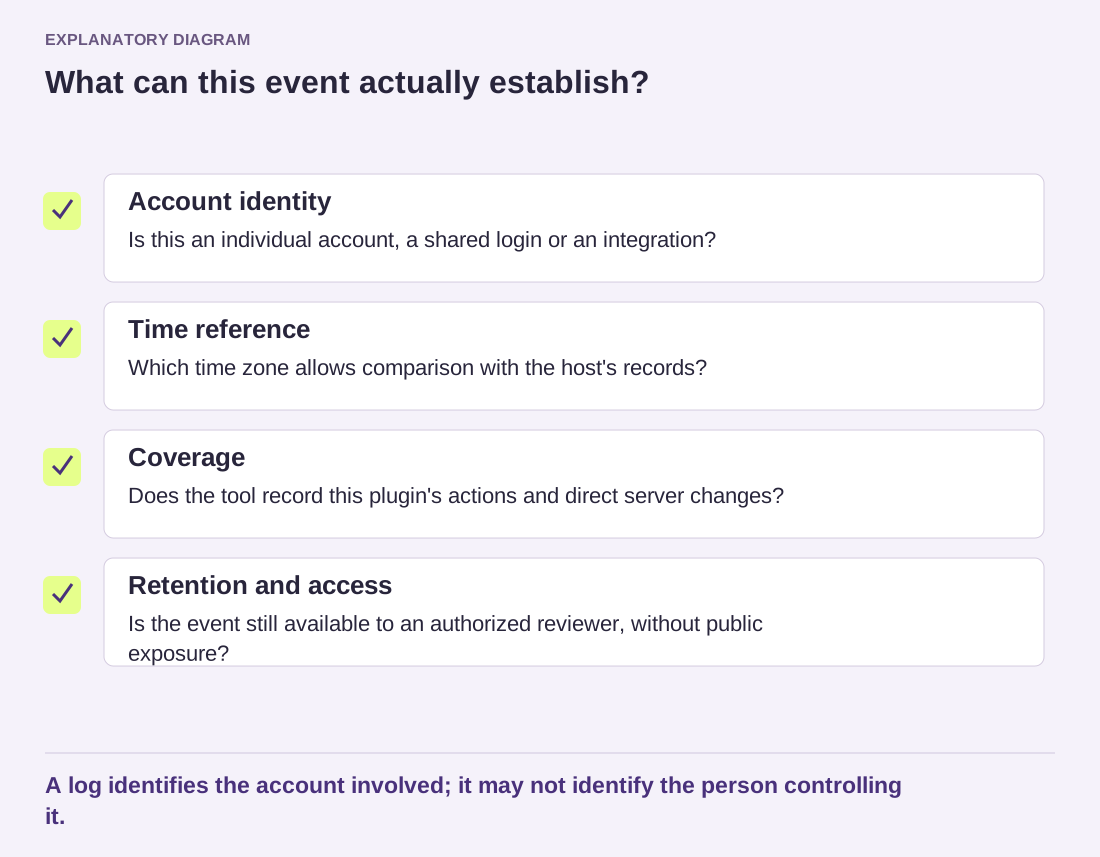
Read the diagram as text
- Account identity: Is this an individual account, a shared login or an integration?
- Time reference: Which time zone allows comparison with the host's records?
- Coverage: Does the tool record this plugin's actions and direct server changes?
- Retention and access: Is the event still available to an authorized reviewer, without public exposure?
A log identifies the account involved; it may not identify the person controlling it.
Restrict access to the log. Event details can contain usernames, IP addresses, content fragments or other information that should not be public. Review what the tool captures and avoid unnecessary sensitive values. Describe relevant processing in the site's actual privacy information where required.
Choose a retention period that fits the operational need and applicable obligations. An unlimited archive is not automatically better. Make sure deletion or rotation works and that storage use does not grow unnoticed.
Test a harmless event, such as a change to an invented draft, and confirm that it appears with the expected details. Establish who reviews alerts or investigates a reported issue. A log that records useful events, preserves them appropriately and has a responsible reader is more effective than a dashboard full of activity nobody knows how to interpret.